Dear Startup Investor:
Our current startup recommendation is a little different.
The previous ones came to us as strangers. We only gave a thumbs-up after becoming absolutely convinced that they were great companies.
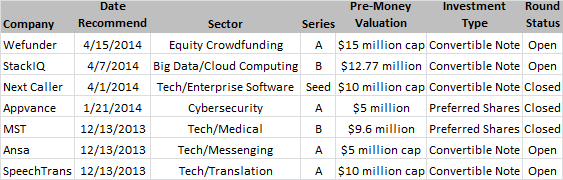
Today we’re recommending Wefunder. And it comes as no stranger to us.
I know this outstanding company and its site specializing in startups very well. Heck, I dip into it almost every day.
Several Wefunder companies have made our “watch” list of top startups. And our last recommendation, Next Caller, was from Wefunder.
It Starts With the Co-Founders
These three founders of Wefunder are no Johnny-come-latelys. They were telling Washington, D.C., to knock down the barriers to early investing long before the popular press “discovered” crowdfunding.
I first talked to co-founder and president Mike Norman last year. He had just gotten off the plane from Peru. He spent the next 45 minutes telling me why equity crowdfunding was going to upend how individuals invest.
That was the day I learned Mike belonged to a rare breed of true believers.
He saw the big potential for profits that startup investing offers to everyday investors. But Mike didn’t let his beliefs blind him to the potential for abuse. New laws have opened up the space to many more investors, and soon they’ll be available to everybody.
The Wefunder site is very much a product of its founders grappling with the yin and yang of belief versus fear. The portal showcases some of the best deals in the startup investing space. It also erects some of the strongest barriers I’ve seen against would-be scamsters.
This unusual combination of profit and protection is why I’ve made Wefunder part of my daily routine. And why I’m now recommending it to you.
A Portal Apart
Investors have noticed, too. They’ve invested $2.5 million in the 20 companies Wefunder has featured on its site.
Mike and his colleagues have used their deep roots in the startup community to attract companies from the country’s top tier of tech accelerators. Three stand out: Y Combinator, Techstars, and MIT.
The founders of Wefunder are alumni of all three. Wefunder itself graduated from the January 2013 winter batch of Y Combinator. Mike brags, “we know the best startups out there because they are our friends.”
If you thought the new world of crowdfunding wasn’t competitive, think again. According to the World Bank, the United States has 344 crowdfunding investing platforms, the most in the world.
These numbers are deceptive, though. Most of these portals don’t allow people to buy shares. Instead, they get discounts, free tickets and T-shirts for their contributions. In the United States, the most well known are Indiegogo and Kickstarter.
Wefunder doesn’t compete with them. It competes with a couple dozen portals that list companies allowed to accept money in return for private shares.
Last year these portals numbered one dozen. Next year there’ll be three dozen. Then more, until at some point, the deal flow fails to keep up with the expanding number of portals. That’s when the sector will consolidate.
Only the strongest portals with the best deals will survive. I have absolutely no doubt that Wefunder will be one of them.
Wefunder easily qualifies as one of the stronger portals. What sets it apart is exceptional deal flow. It attracts serious investors and creates a virtuous circle of deal flow generating investment generating more deals and on it goes.
These Guys Take Security Seriously
Nobody has worked harder to open up early investing to everyday Americans. Nobody. (We’re crossing our fingers that the new enabling regs will be issued this summer or fall.)
And no portal has done more to protect the integrity of its investment opportunities when it finally happens.
Wefunder has taken a number of precautions against the possibility (some say likelihood but that’s a subject for another day) of certain individuals taking the new rules as their own personal invitation to whip up papers for an LLC, create a company website and “explainer” video, and offer a pseudo-product, all in a day’s time. Plus, getting willing cousins to join as co-founders and CTO/advisors.
In short, fraud.
If and when that happens, Wefunder is prepared. Here’s how.
It first performs background checks on the founders/CEOs. It makes sure they are “real people” with no felonies. That’s its first filter.
Its second one is harder to trick. Wefunder only accepts startups that have at least one “known quantity” professional investor as a backer. By known quantity, I don’t mean your retired Uncle Harry. This investor has to have a portfolio of startup investments… a reputation among other professional investors… and a public track record that can be looked up and verified online not only by Wefunder, but also by the “crowd.”
Can you fabricate all of that out of thin air? I doubt it. But just in case…
The third filter is virtually foolproof. A startup must have graduated from a well-known accelerator program like Y-Combinator or Techstars. They, in turn, have done their own substantial due diligence. And, once in the program, they have to perform. Fakers would be found out immediately, if it ever got to that point (which is hard to imagine!).
Why is this so important?
All it takes is the stench of one scandal – one enterprising schemer slipping through the cracks – to bring a portal down. It’s a major risk factor, one that Wefunder has effectively removed from the table.
The Market
What better time to invest than when a market is about to get much bigger. Right now in the United States we have 250,000 accredited investors who actively invest. That’s 5% to 7% of all accredited investors.
Now, consider that about 233 million unaccredited investors will become eligible to invest in startups. Using 5% – the lower end of our range – almost 12 million new investors will pour into the startup space!
Even assuming just 1% will be investing, that’s still over 1 million new investors who will be searching startup portals for investment opportunities.
If they invest just $1,000 each, that’s one billion dollars flooding the online startup space. And if they split that $1,000 between two companies? They’d be investing in 2 million startups (but not 2 million different ones). There’ll be plenty of overlap.
I’m using very low numbers here. The one billion bucks could easily turn into $5 billion, $10 billion or more (though we think Wefunder’s estimate of $50 billion is too high).
Competitive Edge
Wefunder puts individual investors into a single-purpose LLC they call a WeFund. Why?
It makes it easy for a startup to handle many small investors at once. And it doesn’t muck up its “capital table.” Because VCs don’t like that, it could dampen enthusiasm in future rounds.
I believe these WeFunds will play an expanding role when the millions of non-accredited investors begin investing their relatively modest amounts into startups.
Traction
Wefunder charges a 10% carry but is still pre-revenue. It won’t be able to turn this 10% into cash until its companies get bought out or they IPO. That’s when Wefunder gets a piece of several hoped-for huge ”exit events” (IPO or buyout). Its investments are long-term propositions.
But it’s already invested in companies whose valuations have skyrocketed, like Zenefits, Microryza, Freight Farms and Goldbely. Zenefits, for example, came out of Y Combinator with a seed valuation of $9 million. It’s now valued at $70 million.
Upside
Wefunder has capped its next round of funding at $15 million. That means even if its total shares in the next round are valued at $20 million, your shares will still be based on a $15 million valuation.
Angel List is another big startup portal. It’s about 10 to 15 months further along than Wefunder. The two sites take different approaches. Wefunder says that Angel List appeals to investors inside Silicon Valley and Wefunder to those who are outside. And it’s right. So the comparison isn’t exactly apples to apples. Yet, it is Wefunder that is better positioned to ride the tidal wave of individual investors getting their first taste of buying pre-IPO shares.
Angel List’s valuation? $150 million. If Wefunder hits half that amount, you could be earning an over 500% profit.
How to Invest
If you haven’t already, register on Wefunder’s site here: https://wefunder.com/signup. Then go to the Wefunder.com/wefunder. You’ll see a green “invest” box on your upper right. Click on it. It’ll take you to this page. Here you can read all the pertinent details of Wefunder’s fundraiser. Its target is $500K. It has already raised $205K. And it asks for a minimum of $1,000.
You should also click on the document (WeFund LLC Subscription Agreement) that gives you the terms of the WeFund, called the WeFunds Wefunder Fund I. It’s what your money will be going into. The document also asks you to confirm that you are an accredited investor.
If you wish to proceed, click on the new “Invest” box that appears on this page. The page that now pops up will ask you to “read, like and sign” the WeFund LLC Subscription Agreement and the “Disclosure Statement.” To sign these documents, click on the green “Sign Documents” box.
Your funds, like all Wefunder investors, will be placed in an escrow account hosted at Boston Private Bank. They will be transferred to Wefunder only after the fundraising target has been met and the round is closed. There are up to 99 spots reserved for investors in these Funds. So if you wish to make an investment in Wefunder, I advise you do it soon.
Key Stats
Investment type: Convertible note
Yield: 2% APR until shares are converted to equity (upon next qualified financing round)
Cap: $15m
Discount rate: 0%
Sincerely,
Andy
Startup Investor Portfolio