I just read an article this weekend on Target’s (NYSE: TGT) enormous data theft by hackers from Central Europe. The New York Times did a great job detailing how these cybercriminals pulled off a heist of up to 40 million Target customers. Ultimately, it could involve outing more than 70 million phone numbers and addresses.
I urge you to read the article. I knew cybercrime was a growing problem. But this article opened my eyes to how dangerous cunning hackers have become. Even more shocking was how unprepared we are to counter their sophisticated invasive tactics.
In Target’s breach, for example, the coding that enabled the hackers to snatch customers’ data changed according to the instructions received from its handlers, in real time.
Target isn’t alone. Snapchat was recently hacked. The New York Times itself was hacked by China earlier in the year. Dozens of smaller hacks occur that you never hear of. Last year, for instance, a cyberattack traced to Raley’s, a west coast supermarket chain, exposed thousands of credit union customers. They all got new debit cards. It didn’t make national news. I found the news report on a San Francisco TV site.
Investigators think that Target was part of a bigger campaign aimed at another half dozen major retailers. Javelin Strategy & Research says, “We’re expecting this to be a major contributor, if not the primary driver of card fraud for the next 12 months.”
Listen, I have no doubt that your security and mine are already at risk. At least I know mine is. I use Dropbox. It has been accused over the years of allowing security breaches, according to Venturebeat.
I also have a dozen apps on my smartphone. They’re not too safe either, says Kevin Surace, CEO of Appvance. “Every company is rapidly deploying new apps for their customers. They are increasingly hosted in the cloud and made specifically for mobile devices. The problem is, coders have limited knowledge of scalability and security. And most organizations rely on inadequate code analysis tools to reveal security issues lurking in the code and integrations.”
Only One Company Has Stepped Forward
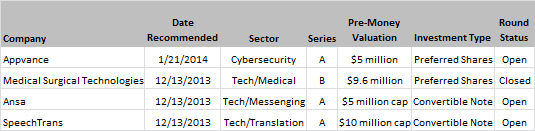
Appvance is the only company I know doing something unique about this growing problem. And that is why I’m recommending this promising startup to you today. I simply cannot see a scenario where Appvance’s diagnostic services won’t be in high demand.
Am I missing something? No, says Derek Conjar, my senior technical advisor. He told me how alarmingly easy it is to slip in code that hacks a supposedly protected system. At peak traffic it would be even easier, he says, adding that the problem is very real and the need for a solution is just as real. “If this company can pull off a solution that really works, it would be amazing,” he added.
Derek said that exploiting system vulnerabilities under stress makes perfect sense. “It’s an approach I would have chosen,” he told me.
Appvance isn’t just tweaking what current security companies like HP (NYSE: HPQ) and Soasta do. It’s going way beyond. HP and Soasta offer first generation and second generation load-testing software. That’s fine as long as you ignore that app developers downplay the security and scalability aspects of their technology.
Appvance uses the cloud to “simulate” millions of users piling into an app simultaneously. Where “white hat” security scans end is where Appvance begins. Nobody has done this before. Appvance has the first third-generation performance testing technology in the cloud. Not only that but it adds security sweeps to find application holes at high-stress and customer-traffic levels.
They are, to date, the only company with this capability.
Appvance is plugging a gaping hole that hackers can easily take advantage of. Says Kevin, “The bad guys know that security holes appear when apps are under stress from attacks or more users than normal.” Yet apps rarely get more than typical white hat “Stage 1” testing. Only Appvance offers “Stage 2” (at heavy loads) and “Stage 3” (failures that occur from something other than load).
So, how did Appvance develop this technology?
They ingeniously took open-source technology that was built from the ground up over 12 years and massively upgraded it while adding to it. The result? A tool-testing technology used for functionality, scalability, security and performance at a level that represents a substantial leap over what is now available.
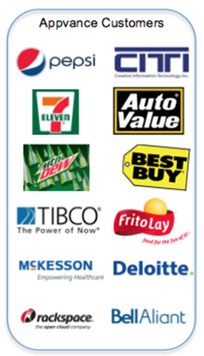
Some of the biggest retailers in the world are now using Appvance’s testing technology, including Rackspace (NYSE: RAX), Pepsi (NYSE: PEP), Frito-Lay, Mountain Dew, McKesson (NYSE: MCK), Bell Aliant (OTC: BLIAF) and 7-Eleven.
Because it diagnoses architecture and code issues under stress, it surfaces more problems than other diagnostic software. Kevin says, “It’s a good thing the results were confidential. I can say that almost no one passes unscathed.”
Our Evaluation
Appvance presents an excellent case for growth. It’s first in a big market addressing a big need (app vulnerability under stress scenarios). Just how big is this market?
According to Gartner, the widely respected research firm, the software diagnostic market is $13 billion a year. Apps would comprise a sector of the market and thus claim some fraction of the $13 billion. As a new and completely uncarved-up segment, I’m not sweating over exact size.
The market opportunity is real and substantial. Let’s leave it at that.
We also like that it’s the first iteration (though we assume not the last) in a new generation of diagnostic technology. Appvance’s mantra of “deeper, broader and better” diagnostic tools is more than a great marketing slogan. Appvance is getting two “seminal” patents for its technology. Wannabe competitors can’t just duplicate Appvance’s technology. Its technological edge is real; its slogan more than empty rhetoric.
(By the way, Surace has been awarded 23 patents in his extremely successful entrepreneurial career, so this is not virgin territory. He was also Inc.’s Entrepreneur of the Year in 2009, one of those rewards that actually mean something. So we strongly believe the company is in very good hands.)
As for the critical issue of traction, we like what we see so far. Appvance began in October 2012, justifiably spending most of its time on getting its technology right. This year it switched focus. The startup will be busy expanding its marketing tentacles. It aims to double its revenue in 2014 and become profitable in 2015. (But by waiting to invest until 2015, you’d be paying much more for your shares. More to the point, it’s unlikely you’d even have the opportunity to invest. This is likely the company’s last fundraising round.)
The company already has a dozen blue chip accounts. It’s not a knock-em dead number but it’s a promising start, especially considering that it has 50 of what Appvance calls “active” accounts in its pipeline. This is where I need to point out some things to you…
The company’s serious revenue-generating days are still in the future. We know what Appvance is planning and what it has in the pipeline. Appvance still needs to execute to turn all this revenue potential into reality.
In terms of pulling in money, Appvance has done very little to date. So there’s always the risk that it will suffer setbacks and never reach its profit goals. Keep this in mind when you’re deciding whether to invest.
But allow me to project possible revenue numbers based on Appvance’s current pipeline. At about $100,000 per customer per year, the company would get $2.5 million of revenue, assuming a 50% conversion rate (which may or may not be reasonable, I should add). The company’s own projections show it reaching this level toward the end of this year (2014).
And if the company’s projected 80% gross margin rate proves accurate, Appvance would experience rapid profit growth once it enters its post-revenue stage, which is set for this year.
The startup finished off the last quarter in 2014 showing over $400,000 in sales. Keeping up that rate in 2014 translates into a 12-month sales total of $1.6 million, which is indeed what Appvance projects.
The Opportunity
Last April Appvance raised $1.1 million in a Series A fundraising round. But the company undershot how much money it would need in the short haul. Less than a year later, it is seeking an additional $500,000. It didn’t want to do another round requiring another set of documentation and pre-money valuation… not for such a relatively modest amount.
So it decided to extend its just completed round from $1.1 million to $1.6 million and keep its Series A $5 million valuation. Only this is not April 2012 anymore.
The company has several blue chip clients now unlike before. It also has a complete team in place. And its “first-in” status in the apps diagnostic space is more established.
If Appvance had decided to do another round right now, its valuation would certainly be much more than $5 million. My estimate is that it would be a double-digit valuation.
So, on top of getting a company with great promise and upside, you’re also getting quite a bargain. Appvance is much further ahead than where it was last spring but the price of its shares has not gone up one penny.
So This Is What You Should Do…
Appvance is listed on AngelList. You can invest in the startup through a “syndicate” led by Jon Staenberg.
Okay, let me explain what a syndicate is and who Mr. Staenberg is.
I like the freedictionary.com’s definition: A syndicate is a general term describing any group that is formed to conduct some type of business.
In this case, Jon has formed a syndicate for the purpose of investing in Appvance. And, importantly, he’s doing it in a way that is more convenient and less risky for accredited investors. Why more convenient?
Your minimum is only $2,500. And Jon told me he’ll give you all the assistance you need to make the payment.
So, why less risky? Jon is an experienced investor himself, having put money into such moneymakers as Infospace, Stubhub, Evite, Spinner, Splunk (Nasdaq: SPLK) and others. All told, he has invested in about 200 startups over the past 20 years. His track record isn’t perfect, of course, but it’s damn impressive.
And he’s putting his money where his mouth is. He told me he greatly admires Kevin’s intelligence and ability to get things done in a startup setting. Of the $600,000 his syndicate is raising for Appvance, he’s putting in $250,000 himself. Not surprising, since he’s known Kevin for over 20 years.
And I won’t be the only one monitoring the company’s progress for you. Jon will be too. You’ll have two people keeping you apprised of the company’s latest developments.
And just like the due diligence you see in this recommendation, Jon has done his too. Once again, you have two parties doing the work for you. Believe me, I don’t mind. The more information you have, the less risk you’re taking. It’s all good.
You can think of syndicates as mini venture capital funds. But instead of shelling out hundreds of thousands of dollars to join, you pay as little as $2,500 and you invest on the exact same terms as Jon does.
The fact is, if Jon doesn’t form this syndicate for you to join, it’s very possible that you would not be able to invest in Appvance. Why?
Many startups don’t like individual investors “nickel and diming” their capital table with relatively small investments. There’s a name for having several dozen investors listed on a capital table. It’s pejoratively dubbed a “dirty cap table.” Many venture capitalists don’t like dirty tables. They prefer fewer than a dozen investors funding a startup’s early growth stages.
Jon will group all your funding into one investment vehicle under his syndicate. And that is how it will appear on Appvance’s cap table. Everybody wins…
Appvance’s future VC rounds (if they happen) aren’t compromised. Accredited investors get more companies to invest in through these syndicates. And experienced investors like Jon leverage their talent and experience to pick their favorite startups and draw other investors into the round.
For these services, Jon makes a 20% profit on whatever gains you make when Appvance is bought out or IPOs. It’s a fair deal. As I said, without Jon’s participation, Appvance probably wouldn’t be available to you. And if the company hits it big, you won’t mind the 20% off the top.
Jon’s syndicate needs to raise $50,000 more. Then Jon is calling it quits. So I suggest you follow up as quickly as you can. I also suggest that you invest the minimum or not much more. That would allow your fellow Chairman’s Circle Members to invest, as well as saving some of your ammunition for investments down the road. Remember, to diversify your portfolio, I’d like you to make about 15 to 20 startup investments over the following 12 months.
Investments will be taken on a “first come, first serve” basis. If you don’t act expeditiously, it’s possible you may not get into the round.
You can invest into Jon’s syndicate by clicking here. You’ll be brought into the investment page of Appvance’s listing on AngelList. From there, all you need to do is follow some simple instructions to become a Series A equity investor in Appvance.
Startup Investor Portfolio