Dear Startup Investor,
This investment opportunity should not exist.
But the Internet of Things – known simply as IoT – is getting off to a slow start.
Not in terms of size. The market is massive thanks to cheap, easily available off-the-shelf sensors.
They’re going into everything…
Cars. Pipes. Factories. Engines. Power grids. Home appliances.
We use millions of personal computers and billions of smartphones. Soon, we’ll be using tens of billions of connected devices.
I’ve seen estimates ranging from 25 billion to 50 billion connected devices by 2020. And trillions by 2025.
Frost & Sullivan says the market is worth $246 billion, of which the military component is just over $20 billion.
The vice president of a Fortune top 25 company (that I’m not able to name because they’re co-investing in this deal) has stated he believes it’s only a matter of time before everything we make exits the factory outfitted with sensors.
The co-investing company itself plans on embedding 17 billion pieces of equipment with sensors in 10 years’ time. They’re one-tenth of the way there.
The vice president says that while this transformation has already started, we’re just at the beginning.
In terms of size and impact, it doesn’t get any bigger than this.
The investment opportunities are very big.
This much is not in dispute.
What is still unclear is who will benefit.
Surprisingly, no one company has taken this market over.
No company is dominant. No technology is dominant. Nor is there even a clear front-runner.
This massive market is still up for grabs.
The One Problem Holding the Market Back
It has a gaping hole. Unless devices come from the same company, they can’t talk or respond to each other.
And as long as that remains the case, issues of incompatibility will slow the market’s development.
In other words, this immense global market is still looking for a champion…
A company that can unify connected devices and overcome the incompatibility problem… A company that other technologies can augment, much like new apps augment the functionality of smartphones.
While it’s still early, such a company would not only unleash the pent-up growth of the potentially massive IoT market, but would also become a dominant force in the IoT space itself.
While hard to pin down exactly, its profitability would certainly be enormous.
The financial rewards awaiting such a company are there for the taking.
Of course, a company would have to have the right kind of technology.
The kind that can talk to sensors regardless of their make or origin.
The kind that can be applied to a specific task or sector without years of product development.
The kind that is easy to use. Easy to scale. Easy to change and adapt to evolving requirements.
If such a company existed, I’d be extremely interested in investing. Such an opportunity does not come along often.
And, yet, remarkably, it’s here right now.
As you’d expect, such a technology doesn’t appear out of the blue. And so it is with this technology and the company responsible for developing it.
MPrest Started Out as a Military Technology Provider
Its software protected Israel from missile attacks. Still does. MPrest developed it for Israel’s air-defense system, called the Iron Dome.
It takes information from thousands of sensors and radars to track incoming missiles. It calculates the missile’s trajectory and decides on a response in seconds – typically launching a missile to intercept it.
Now, mPrest has begun using that very same “command and control” technology for nonmilitary purposes. It has projects in a half-dozen countries. Monitoring and controlling power utility security… smart water infrastructure management… and fleet management. As well as monitoring threats to the coast guard.
It’s also made it over to the U.S. It’s being deployed in an electric grid that is part of the NYPA (New York Power Authority) transmission system.
What Elevates This Technology Above the Others?
For one, it’s incredibly powerful. It controls thousands of sensors, spread among multiple locations, in real time.
For another, its modular structure can be easily customized to individual sectors. Changes made to the underlying technology are minimum.
Some of mPrest’s biggest competitors – Lockheed Martin, Raytheon, Accenture, MER Security and Thales – take a different approach. They’re developing customized systems from scratch.
It takes years – up to a decade in some cases.
MPrest’s technology is also proven, removing the chicken and egg conundrum, and mPrest has a dozen projects, in the U.S., Mexico, Chile, Brazil, Argentina, India and Russia (plus other classified locations).
Enterprise customers don’t have to take a “leap of faith” when signing up to use its technology. Nor do they have to wait several years for a system to be developed from scratch. And then more time wasted as it’s debugged.
And mPrest is targeting utilities first. Makes sense. It’s a $30 billion global market that really needs the type of “monitor and control” technology the company provides.
From there it plans to address other sectors, from smart cities to commercial buildings.
We’ve Seen Defense Companies Succeed Before
There is a track record of success among Israeli companies making the transition from military to commercial…
- Verint (Nasdaq; $3.5 billion cap)
- NICE (Nasdaq; $4 billion cap)
- Check Point (Nasdaq; $14.6 billion cap)
- And Given Imaging (acquired by Covidien for $860 million).
On top of that, mPrest can make a convincing case for itself. If it can do this…

An Iron Dome battery intercepts an incoming rocket during the summer 2014 war (photo credit: IDF)
Then it can do this…
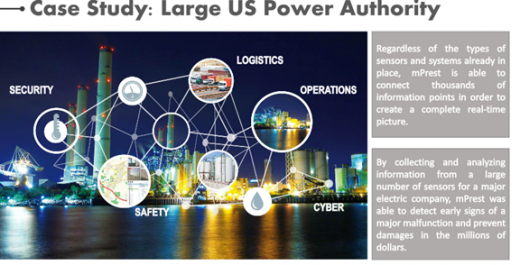
It’s a powerful argument. The IoT has never seen a technology with this level of sophistication, flexibility and scalability before.
The founder and CEO, Natan Barak, admits the main thing holding mPrest back right now is its slim sales budget. The target $25 million the company is raising this round will be used to beef up its sales and marketing team, and, secondarily, to expand its research and development activities.
I had the pleasure of sitting down with Natan and talking about his company while the both of us were in San Francisco.
Natan is aformer commander of the Naval Software Unit for IT and has plenty of experience managing complex projects in the fields of communication, integration, computing and software. I enjoyed our talk.
Natan is a confident CEO, as comfortable explaining technology as he is business growth strategy.
Natan enlisted OurCrowd to help him raise funds. OurCrowd is no stranger to my colleague Adam and me. We’ve worked closely with the portal in the past. And some of our most promising Startup Investor holdings have come via OurCrowd.
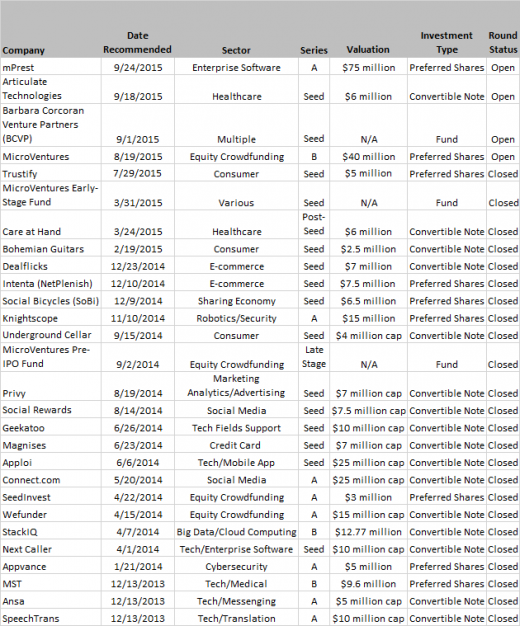
Companies such as Apploi, StackIQ and MST were made available to us via OurCrowd’s website.
OurCrowd is being joined in this round by the venture capital arm of a Fortune top 25 company – a strategic investor with a substantial footprint in the target customer base.
The Deal
You’ll be investing alongside OurCrowd and the Fortune top 25 co-investor I told you about earlier.
MPrest carries a valuation of $75 million pre-money. (After the raise – post-money – the company’s valuation will jump to $100 million because it will take into account the additional $25 million cash injection.)
It generates $25 million of revenue. About 20% is commercial.
The $20 million that is defense-related is projected to grow at a 20% to 30% rate per year.
That’s the part of the company that gives mPrest a stable, predictable and healthy revenue growth, substantially limiting your potential downside.
The company would have to encounter major setbacks among several of its current defense customers, namely the Israel Aerospace Industries (Elta and Malat), Rafael, Elisra, Ituran and the Israel Ministry of Defense.
That is extremely unlikely.
Plus, mPrest has developed a strong partnership with Rafael Advanced Defense Systems (the customer of the Iron Dome), which, by the way, also owns 50% of the company.
So mPrest also boasts an unusual safety net.
It’s another big reason why I like this company so much. It has tremendous upside, but a constrained downside. The risk you’re taking equates more to much later rounds. But not the price. The 3-to-1 valuation-to-revenue ratio is really a good deal.
MPrest’s risk-reward equation is unusually favorable to the investor.
Another risk-reducing factor: You’ll be getting preferred shares with liquidation preference terms. They stipulate an investor return of 1.2X to 2X in case of a distressed liquidation event.
How to Invest
First, sign up with OurCrowd here: https://www.ourcrowd.com/Investor/Create.
Then click “Browse Startups,” and click on the mPrest box. It will look like this…
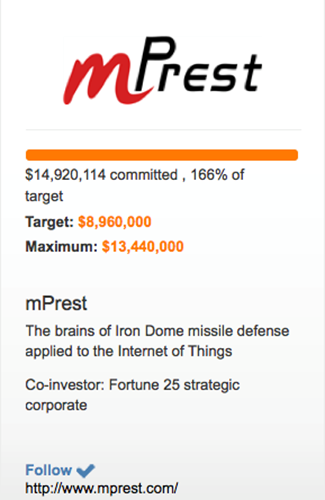
Or click here to access the mPrest page. Then, click the orange “I’m interested” rectangle inside the “Ready to Invest?” box. It looks like this…

Then enter an amount. The minimum is $10,000.
You’ll need to answer a few questions and verify that you’re an accredited investor. If you run into any issues, here is OurCrowd’s contact information:
1.858.546.4316
Investor Relations
[email protected]
OurCrowd’s team will take care of any questions you have. So don’t hesitate to ask them if you need to!
Sincerely,
Andrew Gordon
Startup Investor Portfolio