Dear Startup Investor,
Obamacare…
It’s the most expensive healthcare system in the modern world, right?
If that’s not bad enough, the numbers rarely add up.
Patients either pay too much or too little…
Hospitals get reimbursed too much or not enough…
And doctors get overcompensated or undercompensated.
The government has proven time and again that it can’t wrap its arms around it.
Litigation is out of control. Insurance premiums are out of control. And hospital costs are out of control.
What a mess.
But if the government can’t fix it, then who or what can?
Technology residing in the private sector. It’s going to change the face of healthcare.
And technology coming from incredibly young companies will be playing a big part.
Dr. Andrey Ostrovsky, co-founder and CEO of Care at Hand, heads one of these new companies.
Impressive Fundamentals
Care at Hand has terrific fundamentals. We’ve subjected the company to our in-house 100-hour vetting process. And we’ve given it one of our highest grades. Here are a few reasons why…
- Deep knowledge of Obamacare-mandated payment system. The irrational reimbursement system under Obamacare isn’t going away anytime soon. Dr. Andrey Ostrovsky is a former U.S. Senate Health Policy Fellow on health disparities. He knows where the pain points are.
- Proven technology. As it incorporates more details and becomes more nuanced, it will get even better.
- A motivated customer base. Its customers are losing money. There’s no more effective sales pitch than “we can turn your losses into profits.”
- A powerful partner. It has won over the Public Consulting Group (PCG) as a major investor and distribution partner. With its 350,000 users, PCG represents a major win.
- A revenue-producing business model. The company is continually adjusting to what it finds out about its customers. But the model works. It’s pulling in customers. It’s making money. That risk is off the table.
- The support of two powerful trends. One is predictive analytics. The other involves the transition our healthcare system is making. From a fee-for-service system to a preventive result-oriented approach, it’s putting an increasing value on outcomes.
- Low operational costs. Only $37,000 a month right now. It’s going to get higher, but I have no problem seeing the company spend money on growing revenue.
- A strong leadership. The co-founders are strong technically and business-wise. Practicing Harvard physician Dr. Ostrovsky has surprisingly good entrepreneurial instincts. And former Google and Twitter executive Jeff Levy knows how to grow a business.
Technology to the Rescue
Ostrovsky has come up with an ingenious solution to one of our healthcare system’s biggest money wasters…
The frequent and often avoidable trips to the hospital by the elderly, acutely and chronically ill, and disabled.
Government reimbursements don’t come close to covering the cost. In fact, every time somebody is shuttled to the hospital, the “payer” loses money. About $220 on average, says Ostrovsky.
Care at Hand has figured out a way to turn those losses into gains.
It uses the latest “predictive analytics” technology – along with proprietary algorithms – to drastically reduce hospital readmissions. The company has been able to cut back readmissions by nearly 40%… very impressive.
Payers save $109 per patient per month, or $1,308 per year. By the third prevented admission, Care at Hand’s technology has paid for itself.
So, how does the company do it?
It takes advantage of a widely available, cheap and underutilized group.
Nonclinical workers.
Continuous Patient Assessment
They visit the patient far more often than nurses or doctors. Care at Hand gives them a simple set of questions after every patient visit. Here’s an example…
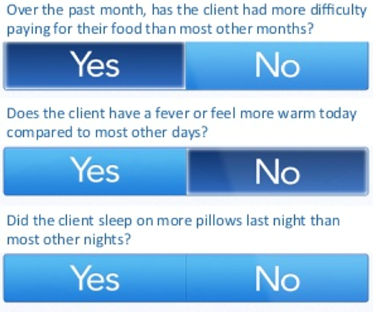
Then the company’s algorithms kick in, creating a chart that looks something like this…
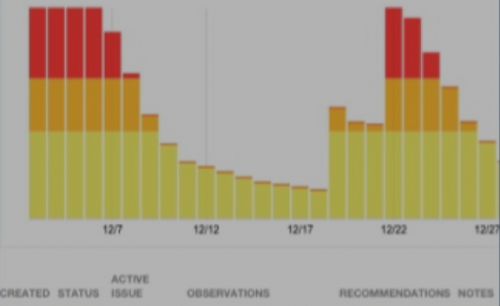
The higher the bars – the more red you see – the higher the risk.
So you can tell pretty quickly how the patient is feeling. And if she or he is at high risk.
The Deal
Care at Hand is raising $500,000 to $750,000 in a post-seed bridge round.
Technically, you’re lending the company money via a convertible note. The plan is to convert the note at the next round.
Here are the terms…
The note is capped at $6 million with a 10% discount. So, whatever the valuation is at the time of the next round (pre-money), you get an automatic 10% discount. If you’re investing $10,000, your $10,000 check will buy you $11,111 worth of shares for a profit of 11.1%.
And if the next round gets a valuation of above $6 million, your immediate profit increases accordingly. For example, if the valuation rises to $10 million, your profit would be an immediate 60% (excluding the 10% discount).
Of course, there’s no guarantee that this will happen. But at the company’s projected rate of monthly recurring revenue, it will be pulling in over $70,000 a month by the end of this year.
Okay, let’s assume a 10X multiple of annual revenue to determine valuation. (It’s more complicated than that. I’m just trying to make a point here.)
If the company does its next round 15 months from now and lives up to its projected revenue model, its valuation should be well over $6 million.
But let’s not get too far ahead of ourselves. We’ll see what happens. But this company has built a strong springboard that should allow it to jump into a higher and sustainable level of revenue generation.
How to Invest
Care at Hand is listed on Onevest. If you’ve already registered with the site, click on the “LOGIN” link in the upper right-hand corner. Fill in your email and password, and click “Login.” Then click on the orange “I’m Interested In Investing” box.
If you have not registered with the site already, click on the “Apply to Start Investing Now” link on the Onevest homepage or the “Login or Apply to Invest” orange box on Onevest’s Care at Hand page. Click on the blue-lettered “Apply to invest,” right under the “Sign in” (see below).
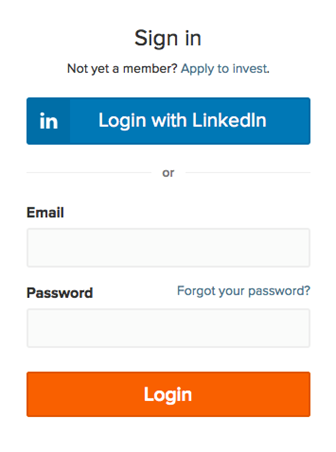
You’ll see this window next…
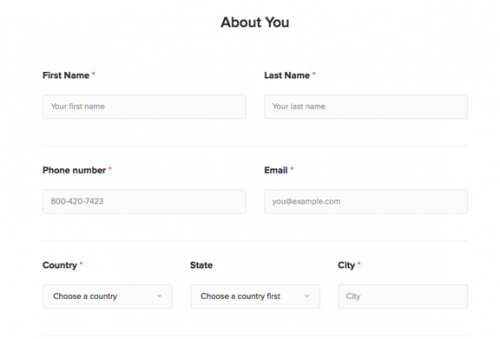
Then hit “Next” (the green box on the bottom of your screen). You’ll next see this…
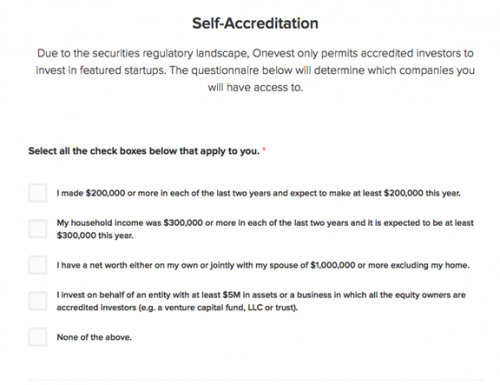
Check the appropriate box (most likely one of the top two boxes) and hit “Next.” Next up is this…
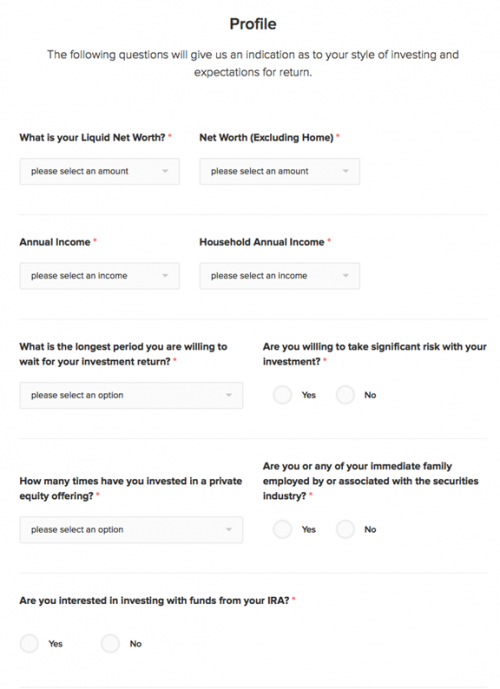
Hit “Next” to get to the window that asks about your preferences…
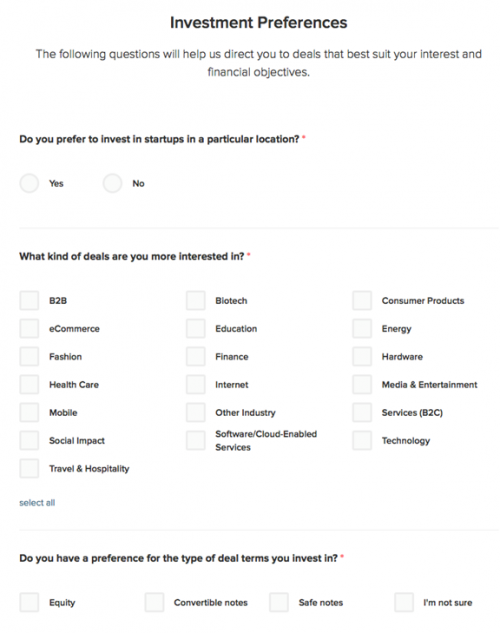
Then hit the green box that says, “All finished.”
At this point, Onevest will get back to you within 24 hours with an approval (or rejection).
Once you’ve been approved, you can go directly to Care at Hand page on Onevest. On the right-hand side, you’ll see this box…
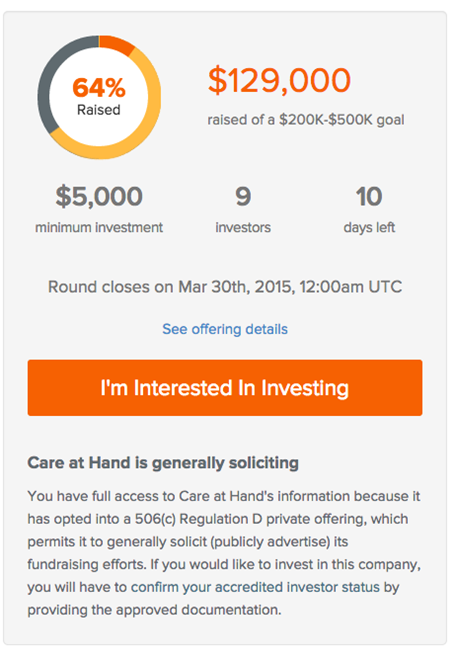
Click on the orange box that says “I’m Interested In Investing.”
Click on the green “Get Started” box and then in the following window put in the amount you wish to invest. It has to be at least $5,000. Hit “Complete” at the lower right, fill out the investor paperwork and you’re done.
Once you’ve been approved, it takes about five minutes to complete an investment.
Onevest will then send you an email with wiring instructions. If you have any questions, you can call Onevest at 1.800.420.7423 ext. 702 or email [email protected].
Again, it’s pretty easy, especially after you do it a couple of times. So don’t get discouraged. Just call or email at the first sign of difficulty and mention my name. You will get all the help you need, so good luck and…
Good investing,
Andy Gordon
Startup Investor Portfolio