101 – What Is Online Startup Investing?
We hear a lot about “game changers,” and “revolutionary changes.”
Most of these “breakthroughs” are marketing hype. Not this one.
Investing in startups online in small amounts is a new, different type of investment. Some people call it “equity crowdfunding”. It’s already live for accredited investors, and should be available to everyone later this year.
Soon, anyone will be able to buy shares in startups online. It’s Kickstarter 2.0. Anybody who wants to buy real shares in companies raising money can.
We’ll all be able to browse promising, early-stage companies. And invest in them for as little as $100.
These changes are coming about due to the 2012 JOBS Act. I won’t bore you with the details of the legislation. You only need to know these two key points:
- Individuals who earn less than $200,000 per year will – for the first time – be able to invest in private companies.
- Companies can now announce that they’re fundraising publicly. This was illegal from 1993 to 2013.
The changes need to be viewed collectively. The sum is far greater than the parts. Not only will private startups be able to tell their stories, everyday investors will be allowed to hear their pitches.
It’s a big deal. The potential returns from this angel-style investing are tremendous. To have the best chance of hitting a home run, you need to be prepared. Let’s get started.
Due Diligence
Research is everything when investing in startups. A study by the respected Kauffman Foundation shows the more time spent on research, the better returns you get.
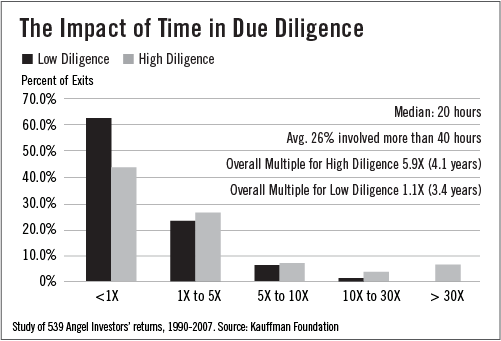
The horizontal axis represents returns. Note how all the 30x-plus are by “high diligence” investors who did 40-plus hours of research per deal.
The lesson: You need to spend more time on research to make the really big gains.
But most people don’t have time to do research full time, like us. So the research you do needs to be highly efficient. Here are some tips…
Due Diligence Tips
Don’t be afraid to pick up the phone. If the company has retailers or distributors, call them. Ask how the product is selling. Do customers like it?
- Use the product if possible. Did you like it? If not, will the company effectively address the problem? Ask them.
- Search for background on the founders and investors. Check Crunchbase.com. It has an easy-to-use database of information on startups, entrepreneurs, VC companies and all the big individual investors.
How Big?
One of the primary goals is to estimate the size of the opportunity. How big could this company get?
What problem does this company solve? Does the opportunity scale? What’s its unique selling proposition (USP)? How big is the market?
And most importantly: Does the product have value? This is a big one for us. If the product doesn’t satisfy the customer, I don’t like it. Even if the traction looks good. See: Living Social…
Frédéric Bastiat said it best, in his 1850s masterpiece The Law.
If you wish to prosper, let your customer prosper. When people have learned this lesson, everyone will seek his individual welfare in the general welfare. Then jealousies between man and man, city and city, province and province, nation and nation, will no longer trouble the world. http://mises.org/books/thelaw.pdf
It may sound idealistic, but let’s frame Bastiat’s statement around Google, one of the best tech success stories of all time.
Google offers excellent value to its users. I’ve been using its advertising service since 2005. It’s simply too profitable to ignore. Google enables advertisers to target customers better than anyone else. It’s a beautiful model.
I bought Google stock once I realized how good its product was, and how much it benefited the customer (me). A symbiotic relationship – where both seller and buyer benefit – is essential for any business that hopes to succeed.
Make sure the companies you invest in actually offer value to their clients. And, like Google, they offer the value in a better way than potential competitors. (I should add that sometimes “better” simply means “cheaper.”) That’s the key to investing, early stage or late.
When possible, check a prospective investment’s online reviews. Beware of “astroturfing,” or fabricated reviews. It’s usually quite easy to spot them, especially on sites like Amazon that verify when reviewers have purchased a product.
The due diligence process is powered by elbow grease. A lot of time spent on Crunchbase, Google Trends, Quancast and Compete, researching the founders and the market. Who are the other investors? What are their track records like?
Google Trends, in particular, is invaluable:
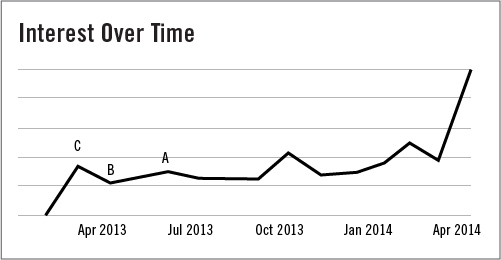
As you can see, interest in the company was spiking when we recommended it back in March 2014 and we knew why. Great dealflow and publicized recent successes.
By the way, we remain bullish going forward. Two points here: See the Google Trend and figure out why it’s happening.
You can learn a lot about (some) startups using Google Trends. But business-business (B2B), or very early stage companies may not have enough search volume to be listed on Trends.
One important note – Trends is better for researching business-consumer (B to C) startups as opposed to B2B ones. Since B2B startups get searched less, the data Google reports is less reliable. So don’t always consider it a red flag if the startup you’re evaluating lacks traction on Google Trends. Depending on the company, it could be right around the corner, or the sample size could be too small for Google to determine accurately.
Great Products Are Usually Affordable
Some investors look at profit margins and ignore everything else. They look at how expensive a product is, and how much the company stands to make versus cost.
It’s important, but only as long as the product is affordable to its customer base. That’s what can build a big business. If it’s what a customer would consider “expensive,” it’s a bad sign. It’s very tough to get traction with a premium-priced product. And it’s even tougher to maintain that traction.
Not to mention… Most companies with high-priced products usually don’t do well in recessions.
In the hospitality industry, for example, discount hotels prosper in tough times, and five-star ones suffer.
Startups are even more vulnerable than luxury hotels in recessions. Low cash reserves, little revenue, not enough access to capital.
To guard against recessions, we recommend investing in companies that can do well in any environment. Startups that can:
- Make their customers money, and profit
- Sell consumers a sexy product
- Disrupt an existing industry, or create a new one.
Young companies offering better service at a lower price do well in any environment, especially in the B2B world.
- Good economy? Good for companies who can increase profit.
- Bad economy? Great for companies who can cut costs.
Bottom line: We like companies that offer value to their customers, make them money and offer them something the bigger companies would have difficulty duplicating
Let’s take a look at Wefunder as an example (it’s one of ourStartup Investor recommendations).
Wefunder is one of the leading portals offering startup investments. And to show that its business model works, it periodically offers shares in its own company, on its own site.
The great thing about Wefunder is that it gets 10% “carry” on every investment made through its site.
Essentially that means that Wefunder keeps 10% of the shares purchased as its fee. It brings the deals to the table, screens them, makes sure they’re not selling Florida swampland, etc. I feel like 10% is a fair price to pay for that. Venture capital firms often charge 20% to 30%.
Test the Product!
If at all possible, test the product. Many startups have free trials or samples. If the company has a $5 app, buy it. The experience, positive or negative, will tell you a lot about the company’s potential.
If it’s a tech company and you’re not a tech person, ask someone you know. Or ask someone online. There are discussion forums based around every niche you can imagine.
For example, if you’re considering investing in an online tax-preparation startup, Google “tax preparation forum,” “tax forum,” etc. Search the posts for your startup’s name.
Convertible Debt
Convertible debt is a common way to invest in startups. The main reason it’s used is because the contract is simple. A convertible debt deal may be five to 10 pages, where a preferred equity contract could be 60.
During the convertible stage, companies are typically very young. They may have “seed money,” or “friends and family” capital to the tune of $100,000 to $300,000.
Gauging how much a company is worth at this stage is hard. It’s difficult to predict how much traction a company will get over the next year. So the company decides to use convertible debt in the hope that its traction gets going by the time it decides to raise again. If it does, it can sell shares at a higher price. So the second key is that debt financing doesn’t require a valuation of the company.
Here are the main points on convertible deals:
- No hard valuation of the company is set.
- The note will be converted into shares based on the terms of the next fundraising round.
- In return for your early investment, you usually get a “discount” on the next round’s valuation of about 10% to 20%.
- Convertibles usually pay interest on the note until it is converted. Two percent to 8% is typical, while some deals offer no interest.
- If there is a “cap,” that’s the maximum valuation your shares will be converted at. For example, if the cap is $5 million, and the round values the company at $10 million, your shares are converted at the $5 million valuation. Essentially giving you twice as many shares as the investors in the next round.
You can learn a lot about a company from its terms. For example, look at the following terms:
- Raising $1.5 million to $2 million – the company’s goal is to raise at least $1.5 million and up to $2 million
- 10% percent discount on next round valuation – you get a discount on the next round’s valuation of 10%. Or your shares are converted at a $15 million valuation. Whichever is more in your favor
- 2% interest on note – you get 2% interest on your money until the note is converted
- A $15 million valuation cap – this is the valuation “cap,” or max on the next round of funding. It’s the highest valuation that your shares will be priced at.
Fraud Watch – Avoiding Shady Deals
To be clear, I don’t expect much equity crowdfunding (ECF) fraud. There are plenty of other easier ways to commit securities fraud.
ECF will be a heavily regulated space (like it or not). A primer on ECF regulation is necessary to understand why.
- The SEC has a team of eight lawyers, each with teams of staffers, to police ECF deals.
- Every deal has to go through a FINRA and SEC-regulated portal or site.
The primary built-in defense in equity crowdfunding is the crowd itself. The investors and prospective investors will serve as the primary “check” on bad actors.
When you have thousands of investors evaluating a deal, cracks will be exposed. All statements on these 506-C deals are on record and under constant evaluation. And the portals where these startups publicize their fundraisers are a second line of defense. The better ones won’t list startups without either well-known entrepreneurs heading them or well-known investors investing in them.
Still, it’s important to be vigilant. I’ve seen a few shady deals listed on ECF portals – most were removed shortly after posting – but it’s something to be aware of.
- Good startups are upfront about their progress; watch out for overly promotional and generic statements.
- Be wary if a company doesn’t say much about its early traction.
- Research the founders and lead investors, check out their profiles on Crunchbase.com and Angel.co. Google them. Search SEC.gov if you’re really suspicious.
The Portals – Where to Invest
There are dozens of portals competing for “dealflow” in the equity crowdfunding space. But only a handful of them consistently offer high-quality investments. Here are the ones to watch:
#1 – AngelList
It’s the original equity crowdfunding site and widely considered to be the cream of the crop. It’s backed by investors including Google Ventures, Kleiner Perkins Caufield & Byers, Marc Andreessen, and many other notable names.
Needless to say, these guys are extremely well connected in the startup community. Co-founder Naval Ravikant was an early investor in Twitter, Uber and many more wildly profitable angel investments.
AngelList has the best volume of all the crowdfunding portals at this time. And it arguably has the best quality as well. It should be your first stop.
One of the unique features AngelList has is Syndicates. A Syndicate allows a well-known investor to list a deal on AngelList. In return, it gets to collect anywhere from 5% to 30% of the upside of the deal (carry).
Key takeaways:
- 5% to 20% carry (cost)
- Five to 10 deals per week
- Considered the first equity crowdfunding site in the U.S.
- Extremely well-connected founders
- Used by major angel investors
Tip: If you like a company that is fundraising, but that’s not yet raising online, you can reserve a spot in case it gets “syndicated.” Simply click on the “invest” button and reserve as little as $1,000 in case it later raises money online.
Promising startups often close their fundraisers in just hours, so this is a backdoor way to reserve your spot. If the round is “oversubscribed,” meaning there is more money or more investors than the size of the raise, you’re more likely to get picked if you invest a larger amount. So if the minimum is $2,000, a reservation of $2,500 is more likely to get an allocation.
#2 – Wefunder
Wefunder may not have the volume AngelList does, but the deals it does get are high quality. It has a close relationship with the well-known startup “accelerator” program, Y Combinator (YC). As a result, it frequently offers YC deals. In fact, it graduated from the prestigious program itself.
One of its deals from March of 2013 has already returned 4,000%. Read more about that here.
A word of advice: When the YC deals go up on Wefunder, the good ones fill up fast. So bookmark the site, and check it regularly.
We’ve spoken with Wefunder’s founder, Mike Norman, many times. We recommended its last investment round to Startup Investorsubscribers.
Mike says that they plan to push hard into non-accredited deals (accessible to anyone, not just the wealthy) when they go live later this year. So if you don’t meet the “accredited investor” definition, you’ll definitely want to bookmark Wefunder.
It’s already had a big success story. Zenefits was listed on Wefunder in early 2013 with a valuation of around $7 million. Less than a year later, it raised money at a valuation of $70 million. Just a few months later, it raised $44 million at a $500 million valuation.
Investors in Zenefits’ round on Wefunder made 2,000% in a little more than a year.
Key takeaways:
- 10% carried interest
- One to two deals per week
- High quality startups
- Good team
- Offers multicompany funds around certain themes
Tip: Wefunder’s funds offer a diversified, low-fee way to invest in multiple startups. Funds are grouped by themes, such as “Y Combinator Summer 2014 fund,” or its “Crowdsourcing fund.”
#3 – FundersClub
FundersClub is another portal with extremely high-quality dealflow. It has an impressive track record, boasting a 47% internal rate of return over the first two years of operation (including fees).
The caveat is that it’s rather expensive compared to AngelList and Wefunder. It charges a 10% fee for administrative costs, plus a 20% “carry” (upside) in the deal. If not all the administrative fees are used, the remainder is returned to investors.
FundersClub is a textbook case of getting what you pay for. Its deals are extremely high quality. And there’s no annual fee on most offerings, unlike a typical VC.
One thing that’s different about FundersClub is it refers to each company as a “fund.” Don’t let that confuse you. It only calls them funds because each investment is structured as a separate LLC.
Key takeaways:
- High-quality offerings
- High fees (25% to 30%)
- Great management
- Excellent fund options (invest in 10 to 15 startups with a single investment)
#4 – Alphaworks
A relatively new player on the scene, Alphaworks has already made a big splash. The first few offerings on its site all sold out in under 48 hours. Its dealflow is high quality, thanks to its sister company, Betaworks, a startup “studio” and investment firm in NYC.
Betaworks has had some big successes, which means it now has access to high-quality dealflow.
#5 – CircleUp
CircleUp is a little different. It only lists consumer product companies: edibles, electronics, tools, toys, gadgets and more.
It has very high quality dealflow. And it has already had some major success stories, such as SmartyPants, a children’s gummy vitamin. SmartyPants has now completed two raises on CircleUp, totaling $4.7 million. And sales are booming (exact numbers are confidential for now).
The minimums on CircleUp are high. Often as high as $20,000.
About Early Investing and Startup Investor
- We are a 100% independent financial research firm.
- We don’t accept compensation in any form from companies or portals mentioned.
- We pay our own travel expenses, meals, etc.
- We work only with reputable, well-regarded startup portals,
- We are not brokers. We do not perform brokerage services.
- We make all our money from the fees we charge for our financial research.